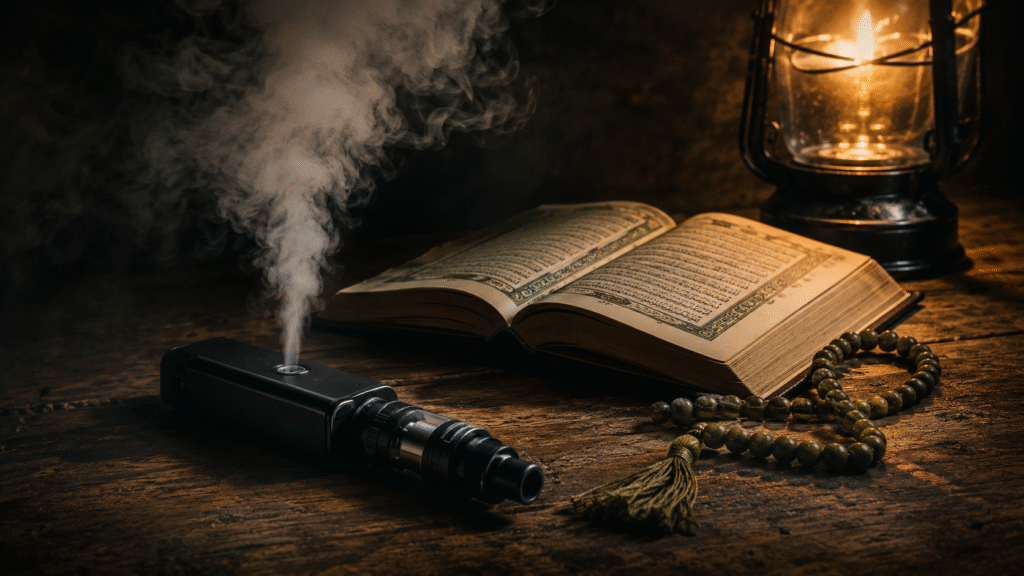
Every Friday, millions of us open to Surah Al-Kahf, move our lips through its 110 verses, and close the page feeling like we’ve done our duty. But how many of us could actually explain what we just recited? We repeat the sounds faithfully and skip the meaning just as faithfully — and that’s the real tragedy of this surah, because it wasn’t sent down to be recited. It was sent down to be understood.
Table of Contents
- Why This Surah, and Why Every Friday?
- Trial One: Faith — The People of the Cave
- Trial Two: Wealth — The Man With Two Gardens
- Trial Three: Knowledge — Musa (AS) and Al-Khidr (AS)
- Trial Four: Power — Dhul-Qarnayn
- Why These Four Trials Together?
- Making Friday Mean Something Again
Why This Surah, and Why Every Friday?
The habit of reciting Surah Al-Kahf on Friday isn’t cultural custom — it’s rooted in a hadith narrated by Abu Sa’id al-Khudri (RA), that the Prophet ﷺ said: “Whoever recites Surah Al-Kahf on Friday, light will shine for him between the two Fridays” (narrated in al-Hakim’s Mustadrak and al-Bayhaqi, graded hasan by scholars including Ibn Hajar). That light isn’t decorative. Scholars describe it as spiritual clarity — the ability to see a test coming before it swallows you whole.
And Surah Al-Kahf [18] is structured almost like a survival manual. Four stories, four distinct trials, one repeated warning: the things that look like blessings are often the very things that break people.

Trial One: Faith — The People of the Cave
A group of young believers flee a society that has turned violently against their belief in one God. They don’t fight, they don’t negotiate — they retreat into a cave and ask Allah for mercy (Surah Al-Kahf [18:10]). Allah puts them to sleep for what the surah describes as around 300 years.
- The test: holding onto faith when the cost of it is everything — home, safety, social standing.
- The lesson: sometimes the most courageous response to pressure isn’t confrontation. It’s protecting your belief even if it means walking away from everything familiar.
This is faith under siege — and it’s the trial every generation of Muslims recognizes in some form, whether it’s social pressure, family expectation, or a culture pulling in the opposite direction of belief.
Trial Two: Wealth — The Man With Two Gardens
Two men, two very different reactions to what they were given. One man’s garden flourishes — lush, fruitful, seemingly permanent — and he starts speaking as though it will never end, even doubting the Day of Judgment because of how secure his wealth makes him feel (Surah Al-Kahf [18:32-36]). His companion warns him gently: attribute it to Allah, not to yourself. The man doesn’t listen. His garden is destroyed overnight.
- The test: does prosperity make you grateful, or does it make you forget who gave it to you?
- The lesson: wealth is a loan with conditions attached, not proof of your own greatness.
Trial Three: Knowledge — Musa (AS) and Al-Khidr (AS)
Musa (AS) — a Prophet given direct revelation — sets out to learn from Al-Khidr (AS), a man given a different kind of knowledge entirely (Surah Al-Kahf [18:60-82]). Al-Khidr (AS) does things that look outright wrong on the surface: sinking a boat, killing a boy, refusing payment for repairing a wall. Musa (AS) can’t hold his tongue each time, and each time, the deeper wisdom is revealed only afterward.
- The test: can you accept that your knowledge has limits, and that Allah’s plan sometimes looks nothing like what you’d expect?
- The lesson: not everything that appears harmful is harmful, and not everything that appears good is good. Certainty is Allah’s alone.
One thing that’s helped me sit with this story rather than just read past it is going through it slowly with a structured tafsir class — I’ve done this through Online Islamic Institute, and having someone walk through the wisdom behind Al-Khidr’s (AS) actions verse by verse changed how I understood the whole story.
Trial Four: Power — Dhul-Qarnayn
The final story is about a just ruler, Dhul-Qarnayn, given immense authority and reach across the earth (Surah Al-Kahf [18:83-98]). Unlike the man with the gardens, he doesn’t let power inflate his ego. He builds a barrier to protect a vulnerable people from oppression, then credits the achievement entirely to Allah’s mercy, not his own skill.
- The test: does authority corrupt you, or do you use it in service of people weaker than you?
- The lesson: power is the loudest trial of all four, because it rarely feels like a test while you’re holding it.

Why These Four Trials Together?
Faith, wealth, knowledge, and power are, arguably, the four things human beings chase hardest — and the four things that destroy people most reliably when mishandled. Surah Al-Kahf isn’t warning us to avoid them. It’s showing us, story by story, what it looks like to hold each one without being consumed by it.
If you want a deeper, guided walk through what each of these trials means for daily life — not just the stories, but the practical extraction of lessons from them — Islahi Majlis has been a genuinely good space for that kind of grounded, scholar-led reflection, and it’s worth exploring if this surah is something you want to actually live with rather than just recite.
Making Friday Mean Something Again
Next Friday, before you open to Surah Al-Kahf out of habit, try pausing on just one story. Ask which trial is closest to your own life right now. Chances are, it’s already speaking to something you’re going through — you just haven’t been listening closely enough to notice.
May Allah grant us the light this surah promises, and the understanding to actually walk by it.
This is exactly why Online Islamic Institute runs dedicated moral and character-building classes alongside our Quran studies — because reciting these stories is only step one. Real change happens when you sit with someone who can walk you through what each trial is actually asking of your character, not just what happened in the story.