
You want your child to learn Quran and Islamic studies properly — not just the basics, but a real, structured education grounded in knowledge and sincerity. You’ve been looking at options, and now you’re facing a question that more and more Muslim parents around the world are wrestling with: is an online Islamic school genuinely as good as the traditional madrasa your parents sent you to? Or is something important lost when learning moves to a screen?
It’s a fair question. And the honest answer is more nuanced than either camp usually admits.
Table of Contents
- What Traditional Islamic Education Actually Offers
- The Real Advantages of Online Islamic Education
- Where Traditional Learning Falls Short in 2026
- What to Look For in a Quality Online Islamic School
- Which Option Is Right for Your Family?
- Also Worth Reading
What Traditional Islamic Education Actually Offers
There’s a reason the madrasa model has survived for over a thousand years. In-person Islamic education offers something genuinely valuable:
- Direct teacher-student connection (ta’lim bil-mushafahah — learning face to face)
- Consistent environment and daily structure
- Peer community and Islamic socialisation
- Correction of Quran recitation in real time
For families living near a qualified, well-structured Islamic school, traditional education still has real strengths. The barakah of sitting with a scholar, being corrected on the spot, and growing up surrounded by other students committed to learning — these aren’t small things.
The Prophet ﷺ said: “Whoever treads a path in search of knowledge, Allah will make easy for him a path to Jannah.” (Narrated in Sahih Muslim) The how of that path matters — but so does whether the path is actually accessible.
The Real Advantages of Online Islamic Education
Here is where the conversation has genuinely shifted in the last few years. Online Islamic education has matured. It is no longer just pre-recorded videos and PDFs.
Quality online Islamic schools now offer:
- Live one-on-one classes with qualified, certified teachers — often more personalised than a classroom of 20 students
- Flexible scheduling that works around school, work, and family life
- Access to qualified teachers globally — a family in Canada, Australia, or rural India can now access the same quality of instruction
- Consistent progress tracking so parents know exactly where their child stands
For many Muslim families — especially those in non-Muslim-majority countries, or in cities where no quality Islamic school exists nearby — online education isn’t a compromise. It’s the best option available.
Where Traditional Learning Falls Short in 2026
This needs to be said honestly. Not every madrasa is equal, and the traditional model has real limitations many parents are only beginning to name:
- Geographical restriction — quality Islamic education is unevenly distributed. The best teachers are concentrated in a handful of cities.
- Fixed schedules — families with multiple children, working parents, or irregular routines struggle to sustain attendance
- Mixed teaching quality — a traditional madrasa is only as good as its teachers. There is no standardisation, no syllabus review, no feedback mechanism for parents.
- Limited options for girls and women — in many regions, quality traditional Islamic education for sisters remains genuinely scarce
If you’re looking for a structured, qualified, accountable option and struggling to find one locally, it’s worth looking at what’s available online. I came across Online Islamic Institute (onlineislamicinstitute.org) when researching this exact question for my own family — they offer live, one-on-one Quran and Islamic studies classes with qualified teachers, flexible timings, and separate options for students in India and internationally. The structure felt genuinely serious, not just a YouTube channel with a sign-up form.
What to Look For in a Quality Online Islamic School
Whether you’re evaluating onlineislamicinstitute.org or any other provider, ask these questions before enrolling:
- Are teachers qualified and can you verify their credentials?
- Are classes live and interactive, or pre-recorded?
- Is there a structured syllabus, or is it informal?
- Can you do a free demo or trial class before committing?
- Is there regular progress feedback for parents?
- Are there separate options for female students taught by female teachers?
Any honest, quality provider should be able to answer all of these clearly. If they can’t, keep looking.
Which Option Is Right for Your Family?
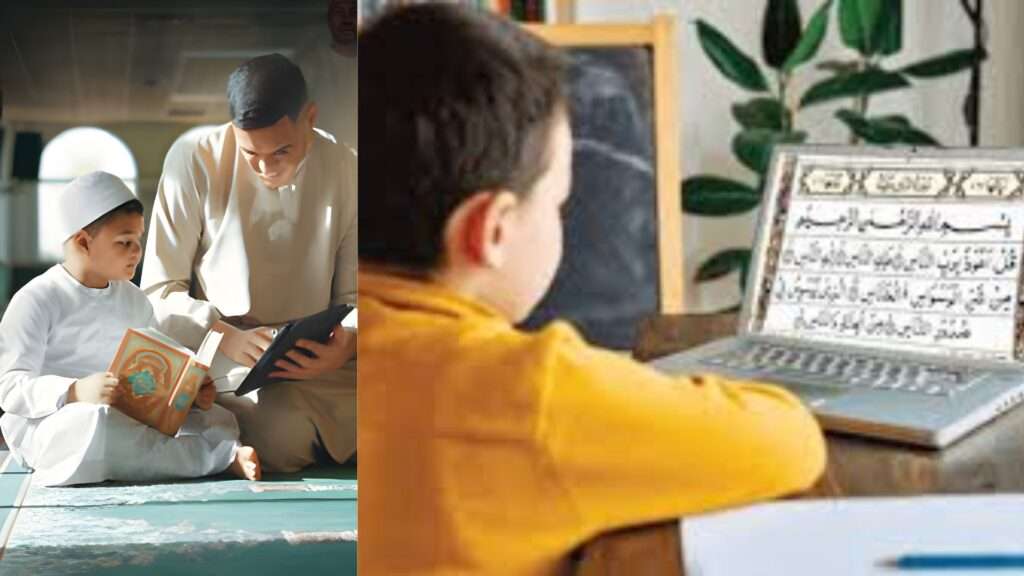
The truth is this isn’t an either/or question for most families. If you have access to an excellent traditional Islamic school nearby — use it. If you don’t, or if your schedule, location, or circumstances make in-person attendance difficult — a quality online Islamic school is not a lesser option. It is a viable, often superior one.
The goal is the same in both cases: consistent, qualified, structured Islamic education for your child. The method is secondary to whether it actually happens.
Also Worth Reading
If you’re figuring out the right age and approach to start your child’s Quran journey, this guide is genuinely useful: https://onlineislamicinstitute.org/best-age-start-quran-learning/
The best Islamic education is the one your child actually receives — consistently, under qualified guidance, in a way that fits your family’s real life. Start with a free demo class, ask hard questions, and make the decision from there.