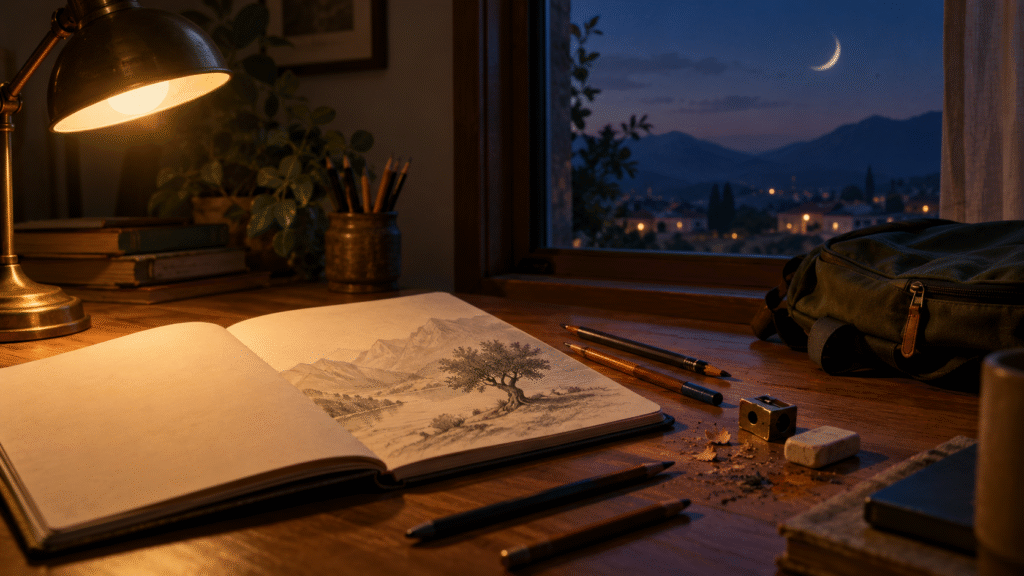
It’s 10 p.m. The art homework is due tomorrow, and the worksheet says: “Draw a cat.” You pick up your pencil, then freeze. Somewhere along the way you heard that drawing living things is haram. Now you’re stuck between a deadline and your deen. If that’s you, or your child, you’re not being dramatic. Is drawing haram in Islam? The honest answer is more nuanced than a simple yes or no.
Table of Contents
- Why This Question Matters for Muslim Students
- What the Hadith Say About Images
- What Scholars Say About Drawing in Islam
- What You Can Safely Draw
- What to Do When Homework Requires a Drawing
- Ease, Intention, and Doing Your Best
1. Why This Question Matters for Muslim Students
I’ve watched this confusion play out in many Muslim homes. Drawing tasks show up in art class, science, even geography. Parents aren’t sure what to say, teachers don’t understand the hesitation, and the student feels guilty either way.
Islam does give us guidance here. But scholars have discussed this topic carefully, so one-line answers on social media often mislead. Let’s slow down and look at it properly.
2. What the Hadith Say About Images
The concern comes from authentic narrations. Aisha (RA) reported that the Prophet ﷺ warned about those who make pictures of living beings, and that they will face severe accountability on the Day of Resurrection (Sahih Bukhari and Sahih Muslim). Ibn Mas’ud (RA) narrated a similar warning in the same collections. It is also narrated that angels do not enter a house containing pictures, which scholars discuss in detail.
Yet the Sunnah shows us a way forward too:
- It is narrated that Ibn Abbas (RA) advised a man who earned his living by making pictures to depict trees and things that have no life (Sahih Bukhari).
- Aisha (RA) played with dolls as a young girl, which scholars mention when discussing children’s toys (Sahih Bukhari, Sahih Muslim).
So the concern is clearly about images of living beings. Trees, rivers, and mountains were never the issue.
3. What Scholars Say About Drawing in Islam
Scholars have understood these texts in a few ways:
- The stricter view: Many scholars, past and present, say drawing living beings by hand is not permitted, even for school.
- The need-based view: Some scholars say the warning targets images made to imitate Allah’s creation or to be venerated, and they allow simple educational drawings when there is a genuine need.
- The incomplete-image view: Some scholars mention that drawing without a face or key features avoids the problem of a complete image.
Statues and idols are treated most severely by all. On one point everyone agrees: drawing trees, landscapes, objects, and patterns is fine.
If you follow a particular madhab, ask a trusted scholar from it. This is an area of respectful difference, so don’t shame anyone for following a valid opinion.
When I hit a ruling like this, I try not to rely on random reels. I’ve found real value in learning from teachers who explain the reasoning behind a verdict, not only the verdict itself. That’s what I appreciate about the Online Islamic Institute (onlineislamicinstitute.org). Having a place to ask and study properly makes questions like this feel a lot less stressful.
4. What You Can Safely Draw
There’s plenty of room to be creative. Safe options include:
- Landscapes, mountains, rivers, and skies
- Trees, flowers, fruits, and plants
- Buildings, cars, bridges, and everyday objects
- Geometric and floral patterns, a beautiful part of Islamic art
- Maps and labelled diagrams of non-living things
A student who loves art can build real skill with these alone.
5. What to Do When Homework Requires a Drawing
If the assignment demands a living creature, try these steps:
- Speak to the teacher kindly. Many will happily swap the task for a landscape or an object.
- Offer an alternative that meets the same learning goal, like a plant diagram or a pattern.
- Parents can email the school. Most schools respect religious needs when asked politely.
- If it’s compulsory and unavoidable, ask a scholar you trust about your situation, since the need-based opinion above may apply.
A calm conversation often solves what anxiety cannot.
6. Ease, Intention, and Doing Your Best
Islam is not against beauty or creativity. Allah says He intends ease for you and not hardship (Surah Al-Baqarah [2:185]), and that He has not placed any difficulty upon you in the religion (Surah Al-Hajj [22:78]).
Taking the rulings seriously and staying gentle with yourself can go together. Do your best, stay sincere, and don’t treat a difference of scholarly opinion as a reason for guilt.
Something that helps me when religious guilt creeps in is Islahi Majlis, a platform focused on Islamic reformation and spiritual guidance. It’s a reminder that the deen is about sincere improvement, step by step, not anxiety.
So back to that 10 p.m. worksheet. You don’t have to choose between your homework and your faith. Ask, adapt, and draw what you safely can. May Allah make our questions a means of knowledge, grant our children ease in school, and guide us to what pleases Him. Ameen.