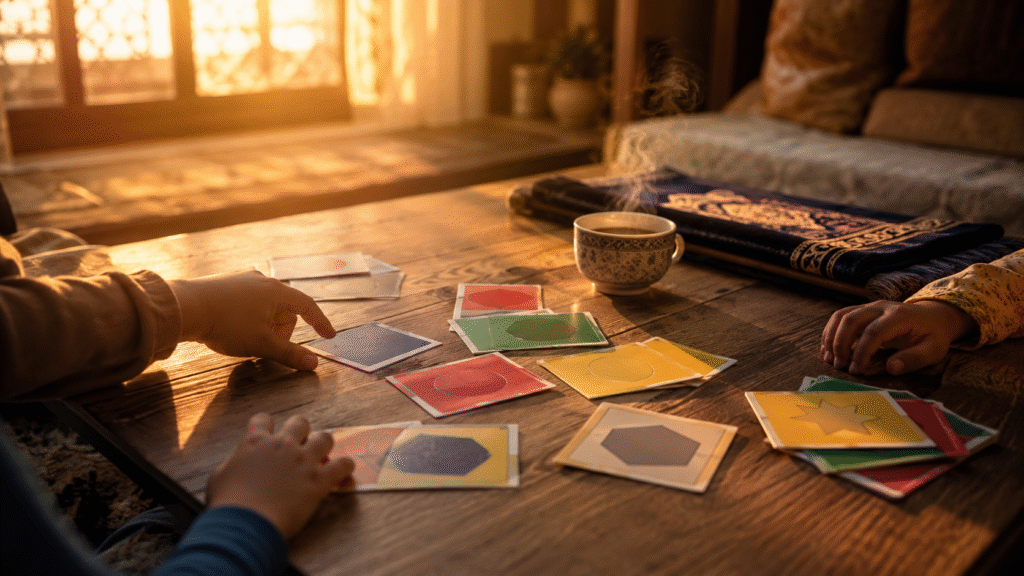
Your kids are giggling over a stack of colorful cards, someone just got hit with a Draw Four, and you’re wondering if you just accidentally let a little bit of gambling into your living room. If you’ve ever paused mid-game to ask “wait, is this actually allowed?” — you’re not alone, and the answer is more nuanced than a simple yes or no.
Table of Contents
- Why This Question Even Comes Up
- What Islam Actually Says About Gambling
- Traditional Playing Cards vs. UNO — Is There a Difference?
- What the Scholars Say About Games Without Betting
- When Family Games Become a Problem
- So Is UNO Okay for Your Kids?
- Making Playtime Purposeful
Why This Question Even Comes Up
Many Muslim parents grew up hearing that “cards are haram,” full stop, without ever unpacking why. That blanket rule usually traces back to traditional playing cards — the ones with kings, queens, and jokers — not to every card game that has ever existed. UNO is a different animal, and it deserves its own honest look.
What Islam Actually Says About Gambling
The prohibition Muslims are really worried about is maysir, gambling. Allah says in Surah Al-Ma’idah [5:90]:
“O you who believe! Intoxicants, gambling, idols, and divining arrows are but a filthy work of Shaitan, so avoid it that you may be successful.”
This ayah is unambiguous: any game where money or valuables change hands based purely on chance is off-limits. If your family UNO night has no wagers, no “loser pays” rule, and no stakes involved, this specific verse simply doesn’t apply.
Traditional Playing Cards vs. UNO — Is There a Difference?
A large chunk of the scholarly caution around card games — even friendly ones without betting — comes from something specific to traditional decks: face cards depicting kings, queens, and jokers, which some scholars view as objectionable imagery. UNO doesn’t carry that baggage. There are no human figures, no royal court, just numbers, colors, and a few action symbols. That removes one of the main objections scholars have historically raised.
[MICRO-AD 1] Whenever I’m sorting through questions like this for my own kids, I lean on the Islahi Majlis platform’s guidance for grounding everyday parenting decisions in solid fiqh rather than guesswork — it’s been genuinely useful for separating cultural habit from actual ruling.
What the Scholars Say About Games Without Betting
Here’s where opinions genuinely diverge. Some scholars maintain that any chance-based card game is at least makruh (disliked), reasoning that outcomes rely on luck rather than skill, similar in spirit to gambling, and that it risks becoming a pure waste of time. Other contemporary scholars take a more measured position: if a game involves no betting, no addiction, no neglect of prayer or responsibilities, and is genuinely just for family bonding or mental engagement, it falls under mubah — permissible.
The Prophet ﷺ never condemned all forms of play. It is narrated that he raced with his wife Aisha (RA) and encouraged physical and mental recreation within healthy limits. Scholars often point to the general hadith principle that “actions are judged by intentions” (narrated in Sahih Bukhari) when weighing borderline entertainment questions like this one.
When Family Games Become a Problem
The ruling can shift from fine to problematic depending on how the game is played, not the game itself:
- If it becomes a betting game, even with snacks or small prizes as “stakes,” it edges toward gambling.
- If it causes real anger, insults, or broken relationships between siblings, that crosses into harm Islam explicitly discourages.
- If it consistently pulls kids away from Salah, homework, or Quran time, it’s become an unhealthy habit rather than harmless fun.
So Is UNO Okay for Your Kids?
Based on the majority of contemporary fiqh guidance, UNO played purely for fun, with no wagering, no objectionable imagery, and no interference with religious obligations, falls into the permissible category for most households. It’s a reasonable, low-risk way for children to build number recognition, strategy, patience, and sportsmanship — as long as parents keep an eye on time and temperament at the table.
[MICRO-AD 2] This is actually the same lens we use at Online Islamic Institute when parents ask us about everyday “gray zone” activities for their kids — we try to give real answers instead of just repeating what everyone’s grandmother said, because raising confident young Muslims means being able to explain why, not just what.
Making Playtime Purposeful
Islam doesn’t ask families to strip all joy out of childhood — it asks for intention and balance. A round of UNO after Maghrib, free of stakes and free of shouting matches, can be a small act of connection rather than a source of guilt. The goal isn’t to avoid fun; it’s to make sure fun never quietly displaces what matters more.
May Allah make our homes places of both worship and warmth, where our children learn that being mindful of Him doesn’t mean giving up laughter — it means learning where the line is, and playing well within it.
This is exactly the kind of question we love tackling with families at Online Islamic Institute — beyond just fiqh Q&A, our certified teachers work directly with kids to build a real, confident understanding of their deen, not just memorized rules. If you want your children learning from qualified Hafiz, Alim, and Mufti teachers in small, personal classes, it’s worth grabbing a free trial class to see the difference for yourself.
Register for free Demo:https://share.google/oNltt3kf0Jj41JVNY