
You’ve searched “online Quran classes” and gotten a hundred results — smiling thumbnails, five-star badges, “expert tutors” plastered everywhere. But how do you actually know if the person teaching your child (or you) has real qualifications, or just a good microphone and a marketing budget? This is the question every serious parent and learner eventually has to ask, and most platforms hope you never do.
Table of Contents
- Why Certification Actually Matters Here
- The Titles You Should Recognize
- Red Flags of an Uncertified Tutor
- Questions to Ask Before You Pay
- What a Properly Vetted Institute Looks Like
- Making the Right Choice for Your Family
Why Certification Actually Matters Here
Teaching Quran isn’t like teaching a language app skill. Tajweed mistakes, mispronounced Arabic letters, or shallow understanding of Islamic rulings can shape a child’s relationship with the Quran for years. An uncertified tutor might mean well, but good intentions don’t correct a misplaced makhraj or explain a hadith accurately.
The Titles You Should Recognize
Legitimate Quran and Islamic studies teachers usually hold recognized qualifications. Look for:
- Hafiz — has memorized the entire Quran
- Qari — trained specifically in Tajweed and correct recitation
- Alim / Alima — has completed formal Islamic scholarly studies (male/female respectively)
- Mufti — qualified to issue religious rulings, relevant for deeper fiqh questions
A platform should be able to tell you, clearly and specifically, which of these titles each teacher holds — not just “our teachers are qualified.”
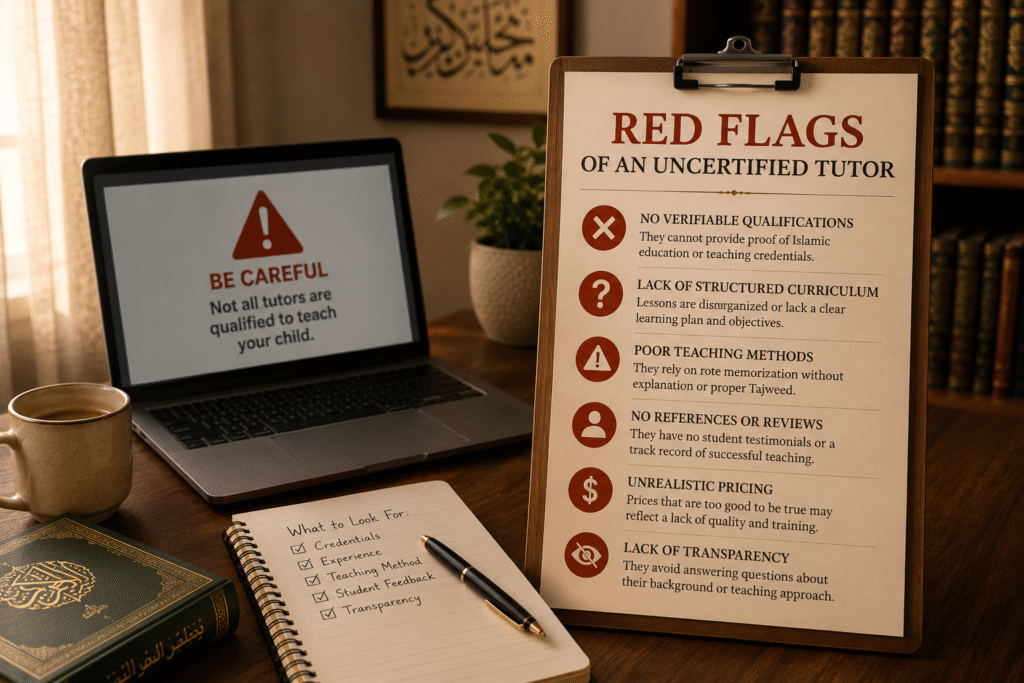
Red Flags of an Uncertified Tutor
Before enrolling, watch for these warning signs:
- Vague bios with no mention of a specific qualification or ijazah
- No trial class offered — legitimate institutes let you evaluate the teacher first
- Inconsistent recitation or hesitant Tajweed during a demo
- No visible process for teacher training, testing, or quality checks
- Pressure to pay upfront before you’ve seen a single class
If a platform can’t answer “how do you train and test your teachers,” that’s usually your answer right there.
Questions to Ask Before You Pay
A few direct questions will filter out most uncertified options fast:
- What is this teacher’s exact qualification — Hafiz, Qari, Alim, Alima, or Mufti?
- How are teachers tested before and after being hired?
- Is there ongoing monitoring, like class reviews or student feedback?
- Can I book a free trial before committing to a monthly fee?
Any serious institute will answer these without hesitation.
This is actually one of the things I appreciate about Online Islamic Institute — every teacher there is a vetted Hafiz, Alim, or Mufti, and it’s not just a claim on a landing page. Teachers go through a month of paid training, get tested afterward, and only continue teaching if they meet the standard. Classes stay small too, so your child (or you, if you’re the one learning) isn’t lost in a crowd of twelve other students trying to get a word in.
What a Properly Vetted Institute Looks Like
Beyond the teacher’s title, a trustworthy platform usually has visible quality control built in — not just at hiring, but ongoing:
- Surprise class check-ins by supervisors
- Recorded lesson reviews (sometimes called “sabaq” reviews)
- Regular student testing by a different teacher, to catch bias
- Anonymous parent/student feedback loops
These aren’t small details — they’re the difference between a tutor who’s accountable and one who simply shows up.
Also Worth Reading
If you’re weighing your options more broadly before settling on a tutor or platform, this piece on choosing the right online Islamic education route is worth a look — it walks through what to compare beyond just price.
https://onlineislamicinstitute.org/unlocking-the-power-of-online-islamic-education-a-path-to-spiritual-growth-🌟/
Making the Right Choice for Your Family
At the end of the day, certification isn’t about chasing a fancy title — it’s about making sure the person teaching Quran actually knows what they’re teaching, and is accountable for how they teach it. Take the free trial class seriously, ask the direct questions, and don’t be shy about walking away if the answers feel vague. Your child’s — or your own — connection to the Quran deserves a teacher who’s earned the right to guide it.