There is a question I want you to sit with for a moment.
If someone told you there was a window — just ten days — where every single good deed you performed was more beloved to Allah than the same deed done on any other day of the year, including the last ten nights of Ramadan — would you let it pass quietly?
Most of us do. Every year.
The first ten days of Dhul Hijjah arrive, the Hujjaj travel to Makkah, Eid approaches, Qurbani is arranged — and for the majority of the Ummah sitting at home, these ten days slip by like any other week. That changes today.
Table of Contents
- Why These Ten Days Are Unlike Any Other
- What the Prophet ﷺ Actually Did in Dhul Hijjah
- The Day of Arafah — The Crown of These Ten Days
- The Power of Sadqa in These Blessed Days
- Eid al-Adha and the Muslims Nobody Remembers
- Simple Deeds That Carry Enormous Weight
- How to Make These Ten Days Count
Why These Ten Days Are Unlike Any Other
Ibn Abbas (RA) narrated that the Prophet ﷺ said: “There are no days in which righteous deeds are more beloved to Allah than these ten days.” The companions asked, “Not even jihad in the path of Allah?” He ﷺ replied, “Not even jihad in the path of Allah — except for a man who goes out with his life and his wealth and returns with neither.” (Sahih Bukhari)
Read that again.
These are not ten ordinary days with extra reward attached. These are the days Allah Himself swore by in the Quran. In Surah Al-Fajr [89:1–2], Allah says: “By the dawn. And by the ten nights.” The majority of scholars of tafsir — including Ibn Kathir — hold that these ten nights refer to the first ten days of Dhul Hijjah. When Allah swears by something in the Quran, it is because that thing carries immense significance.
In 2026, these days begin on 18th May. You have weeks to prepare. Not hours.
What the Prophet ﷺ Actually Did in Dhul Hijjah
The Prophet ﷺ did not simply acknowledge these days — he lived them differently.
He ﷺ fasted the first nine days. He increased his dhikr — specifically Takbeer (Allahu Akbar), Tahmeed (Alhamdulillah), and Tahleel (La ilaha illallah). He gave sadqa. He encouraged his family to do the same.
This is the blueprint. Not a complicated one. Not one that requires you to be a scholar or a sheikh. Fast when you can. Fill your tongue with dhikr during your commute, your cooking, your work breaks. Give something — anything — every single day of these ten days.
The Prophet ﷺ said: “There are no days greater in the sight of Allah, nor in which good deeds are more beloved to Him, than these ten days.” (Sunan al-Tirmidhi)
The Day of Arafah — The Crown of These Ten Days
Of all ten days, the 9th — the Day of Arafah — stands alone.
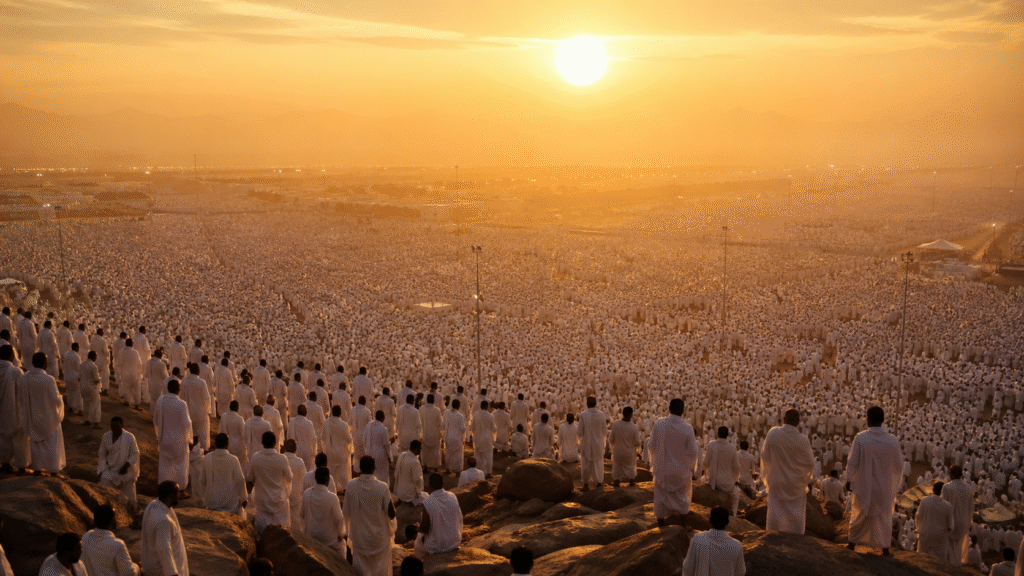
On 26th May 2026, millions of Hujjaj will stand on the plain of Arafah, weeping, making du’a, seeking forgiveness in what scholars describe as the greatest gathering of worship on earth. For those of us not making Hajj, the Prophet ﷺ left us a gift: fasting on this day.
The Prophet ﷺ was asked about fasting on the Day of Arafah. He ﷺ said it expiates the sins of the previous year and the coming year. (Sahih Muslim)
One fast. Two years of sins.
But Arafah is also — and this is what most people overlook — one of the most powerful days to give charity. Your sadqa on this day lands in a moment when the mercy of Allah is descending in waves. It coincides with the greatest act of collective worship on earth. Do not treat it as just a fasting day. Make it your biggest giving day of the year as well.

The Power of Sadqa in These Blessed Days
Charity given in Dhul Hijjah is not equal to charity given in any other month. The multiplication of reward during these days applies to every righteous act — and sadqa is among the most beloved of those acts.
If you have been meaning to give Zakat, give it now. If you have been putting off helping a family in need, do it this week. If you have loose change sitting in an account, move it.
For those looking to deepen their understanding of why sadqa carries such weight in Islam — the spiritual, the scholarly, the practical — I’d genuinely recommend spending time with the resources at Online Islamic Institute (onlineislamicinstitute.org). It’s where I’ve personally gone back to sharpen my own understanding of acts of worship like this, and their material on charity and ibadah in blessed times is worth reading before these days begin.
Eid al-Adha and the Muslims Nobody Remembers
Eid al-Adha falls on 27th May 2026.
For most families, it is a day of celebration — new clothes, Qurbani meat, gatherings. But in every city, in every country, there are families for whom Eid arrives like any other day. Widows. Orphans. Daily wage workers whose income stopped. Families too embarrassed to tell anyone they have nothing.
In India alone, there are hundreds of thousands of Muslims living in invisible poverty. No one photographs them. No campaign features them. They sit quietly on Eid morning while the rest of the Ummah celebrates.
PurChasing Jannah has been finding these families since 2016 — verifying every case personally, delivering directly, without photos, without reducing people to their worst moments. Over a thousand lives impacted. Nine years. Not a single salary taken by their team.
PurChasing Jannah — Ethical Learning Foundation https://share.google/oJRigHilj4QcWtcrL
Your Zakat and sadqa in these ten days — given through a channel like this — does not just feed a family. It gives someone their dignity back on the most joyful days of the Islamic year. That is not a small thing.
Simple Deeds That Carry Enormous Weight
You do not need to overhaul your life for ten days. You need consistency.
- Fast as many of the first nine days as you can — especially the 9th
- Say Takbeer, Tahmeed, and Tahleel throughout your day
- Give sadqa every single day — even ₹50, even $1
- Read extra Quran — even one page after Fajr
- Make sincere tawbah — these days are a door of forgiveness
- Pray your Sunnah prayers — don’t let them slip
The scholars at Islahi Majlis remind us that spiritual transformation in Islam is rarely dramatic — it is built through small, consistent acts performed with full presence and sincere intention. These ten days are your annual reset. Use them like one.

How to Make These Ten Days Count
Set a reminder for 18th May. Write down your intentions tonight. Tell your family. Plan a daily sadqa amount — even a small one. Choose one extra act of ibadah to commit to.
And then show up. Every day. All ten.
The Prophet ﷺ used these days as no ordinary man would. He treated them as the most precious stretch of the calendar. We have been handed the same ten days, the same opportunity, the same open gate of reward.
May Allah allow us to reach Dhul Hijjah in health and iman. May He accept every deed we offer in these blessed days. And may He make us among those who did not let this window pass.
آمين
If you want to go deeper into the spiritual significance of these ten days — the scholarly reasoning behind why these deeds carry such extraordinary weight, the fiqh of fasting in Dhul Hijjah, and how to structure your ibadah across all ten days — Online Islamic Institute has some of the most accessible and well-researched material I’ve come across. It is the kind of resource that does not just tell you what to do but helps you understand why — and that understanding is what transforms routine worship into something that actually changes you. Visit at onlineislamicinstitute.org before 18th May arrives.