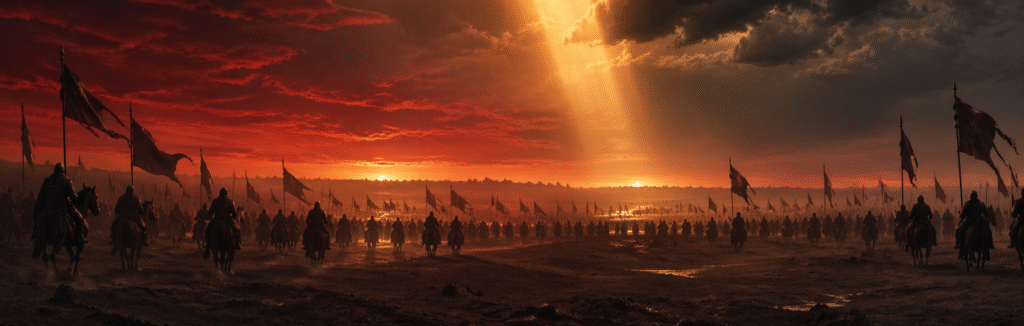
Every time I open my phone and see what is happening in Gaza, in Al-Aqsa, across the Muslim world — something stirs deep inside me. Not just grief. Something older. A feeling that we have been here before, prophetically speaking. That these are not random events. That something enormous is approaching. The question that keeps surfacing — the one Muslims are whispering in group chats and debating after Jumu’ah — is this: Is the army of Imam Mahdi already being prepared?
Table of Contents
- Who Is Imam Mahdi — and Why Does It Matter Right Now?
- The Signs We Were Told to Watch For
- The Army of the Black Flags: What the Hadith Actually Say
- Palestine, Al-Aqsa, and the Prophetic Connection
- What Scholars Say: Caution and Hope Together
- How Should We Respond as Muslims Today?
Who Is Imam Mahdi — and Why Does It Matter Right Now?
Imam Mahdi — whose full name, as narrated in hadith, will be Muhammad ibn Abdullah — is one of the most significant figures in Islamic eschatology. The Prophet ﷺ described him as a man from his own lineage who will emerge in a time when the earth has been filled with oppression and injustice, and he will fill it back with equity and justice. This is not fringe theology. Belief in Imam Mahdi is grounded in authentic narrations accepted across major schools of Islamic thought.
What makes this feel so alive today is the sheer weight of current events pressing against these prophecies. Muslims everywhere are watching the bloodshed in Palestine, the turmoil in the Muslim world, the drying of rivers, the erosion of moral foundations globally — and returning to the hadith literature with fresh, urgent eyes.
The Signs We Were Told to Watch For
The Prophet ﷺ did not leave us without guidance. Across narrations collected in sources like Sahih Muslim and Sunan Abi Dawud, scholars have categorised the signs into minor and major ones. Among those frequently discussed today:
- Widespread bloodshed and unprecedented global conflict
- The occupation and struggle over Bayt al-Maqdis (Jerusalem)
- Economic collapse and growing inequality
- A decline in authentic Islamic scholarship
- The Euphrates River receding to reveal something beneath it — scholars note that Turkish dam construction has dramatically lowered water levels in recent decades
None of these, scholars are careful to stress, constitute definitive proof that the time of Imam Mahdi is imminent. Only Allah ﷻ knows the Hour. But they are undeniably thought-provoking.
The Army of the Black Flags: What the Hadith Actually Say
Perhaps no prophecy fires the Muslim imagination more than this one. It is narrated that the Prophet ﷺ said: “When you see the black flags coming from the direction of Khurasan, go to them even if you have to crawl over snow, for among them is the khalifah of Allah, the Mahdi.” — recorded in Sunan Ibn Majah and narrated via Thawban (RA).
Khurasan historically referred to a vast region encompassing parts of modern-day Afghanistan, Iran, Central Asia, and Pakistan — a multi-ethnic, multi-national civilisational zone. Scholars consistently caution that this does not designate any single nation or group today. The “army” described is one defined by righteousness, justice, and truth — not by geography or flag design alone.
It is also crucial to understand that hadith scholars have debated the chains of transmission for various black flag narrations. Some are graded as hasan (acceptable), others are disputed. The honest Islamic position is that we treat them with scholarly care, not social media certainty.
If you want to dive deeper into the prophetic sequence surrounding Imam Mahdi’s arrival — the signs, the historical context, and how these events connect to what is unfolding today — I strongly recommend watching this detailed breakdown by Dr. Abu Hamza, founder of Online Islamic Institute, who covers four clear signs that Imam Mahdi may be drawing near: 4 Clear Signs Imam Mehdi is on His Way. His analysis bridges classical scholarship with a grounded, modern lens — the kind of content that actually makes you think.
Palestine, Al-Aqsa, and the Prophetic Connection
Masjid al-Aqsa occupies a central place in Islamic prophecy. It was the first qibla of the Muslims, the destination of the Prophet’s ﷺ miraculous Night Journey (Isra wal Mi’raj), and according to multiple narrations, it is connected to the final chapter of history. The Prophet ﷺ said — as narrated in Sahih Bukhari — that there will always be a group from his Ummah fighting for the truth in the region of Bayt al-Maqdis until the Day of Judgment.
What is happening to the Palestinian people is not just a political crisis. From an Islamic standpoint, it is a test — for the Ummah’s conscience, its unity, and its relationship with the divine covenant over this blessed land. Scholars remind us that victory for Al-Aqsa is promised. The question is not if — it is when, and whether we will be among those who stood firm.
What Scholars Say: Caution and Hope Together
Responsible Islamic scholarship holds two truths simultaneously: these prophecies are real and must be taken seriously, and Muslims must never claim certainty about their precise timing or application.
Misuse of these narrations has caused real harm — extremist groups have weaponised the black flag prophecy to recruit and justify violence. Authentic scholarship resists this firmly. As contemporary scholars explain, Imam Mahdi’s mission will be defined by justice and mercy, not by terrorism or chaos. The army that supports him will be recognised not by their flags, but by their character.
For those wanting a deeper spiritual foundation as they navigate these times, Islahi Majlis is a platform I have personally found grounding — its focus on Islamic reformation and inner spiritual development is exactly what the Ummah needs when the world feels destabilised. Keeping the heart connected to Allah ﷻ is not separate from understanding the End Times — it is the prerequisite.
How Should We Respond as Muslims Today?
The Prophet ﷺ said — as narrated in Sahih Muslim — that whoever lives to see the Dajjal should recite the opening verses of Surah Al-Kahf for protection. The consistent prophetic guidance for times of fitna (tribulation) is: hold to knowledge, hold to community, hold to sincere worship.
Awaiting Imam Mahdi is not a passive act. It calls us to become the kind of people worthy of that era — just, grounded in knowledge, spiritually awake.
As I close, I think of Surah Al-Qasas [28:5], where Allah ﷻ says He willed to show favour to those who were oppressed in the land and make them leaders and heirs. That promise was given once before, in the darkest moments of a people who had nothing but faith. It is being invoked again today. Whether or not Imam Mahdi’s arrival is near — and only Allah knows — the duty of every Muslim remains the same: trust in Allah’s plan, act with justice, and never lose hope.
May Allah ﷻ grant us the ability to recognise the truth when it arrives, give us the wisdom not to be deceived, and make us among those who stand on the right side of history. Ameen.
Kindly Support us by reading this blog about SIX things that will happen BEFORE the dajjal:
https://onlineislamicinstitute.org/6-things-that-will-happen-before-dajjal/